The following is meant to be an admittedly incomplete resource for supplemental information on kettlebell lifts taught at this past weekend's Kettlebell Fundamentals workshop at Edge Performance Fitness.
Warm ups, mobility, and flexibility are going to be of utmost importance for most of us, and what most of us that sit most of the day (as I type this) need most.
Here is a good routine from Steve Cotter. Search around for others of his as well.
Russian champion Igor Morozov display the kind of joint mobility that can be attained through years of training.
Now on to the lifting, first up is Steve Cotter breaking down the basic swing technique, including discussion of the importance of the hip hinge, breathing, and developing awareness, relaxation, and efficiency.
Next Ivan Denisov demonstrating clean and jerk (long cycle) technique during a world record setting competition. Might as well learn from the best!
The clean and jerk contains 3 movement we went over: swing, clean, jerk. Although we did push press and not jerk, the two lifts are close in nature.
Denis Kanygin breaks down the clean and jerk technique
This should be enough to chew on for awhile.
Showing posts with label Steve Cotter. Show all posts
Showing posts with label Steve Cotter. Show all posts
Tuesday, December 7, 2010


Wednesday, August 11, 2010
Perform Better 3 Day Function Training Summit in Long Beach
Review of the Perform Better 3 Day Functional Training Summit Long Beach
August 6-8, 2010
I just got back from Perform Better's annual festival of brain overload, otherwise known as the Functional Training Summit, and know that I had better start digesting what was dished out over the weekend before it fades into just a collage of extremely smart people. There is no way to try and review each session I attended, as that require a separate hard drive, but there were some themes that connected many of the talks.
The first day started out at the acceptable hour of 9am. Everyone knows trainers hate getting up early more than anyone. Upon walking in we ran into the regulars in the lobby: Robert Dos Remedios, Bill Hartman, Dewey Nielson of Impact Jiujitsu, Craig Rasmussen of Results Fitness, Rachel Cosgrove among others. Free coffee draws them like flies.
While still signing in Steve Cotter, kettlebell coach and all around athletic freak, came by so we after the obligatory bro-hug I asked if he might need some assistance in his 9am hands-on session. I knew the place was going to be packed so I had worn my IKFF coach shirt, and Steve was gracious enough to let me help out. There were about 300 people in the room swinging iron balls the entire hour, which caused me to be quite cautious when attempting to navigate my way around.
Steve is a master teacher, and it really shows in his ability to command and effectively instruct such a huge group. Judging by the smiles afterward, and the line of people waiting to talk to Steve he was successful in conveying some key concepts in classical kettlebell lifting. His presentation focused on the sport lifts of the jerk, clean and jerk, and snatch. Along with that he broke down the form of each and why proper form is key to development, progression, and staying injury free. In other words Steve focused on movements that work the entire body, and stress developing a high degree of movement quality, joint mobility, joint stability, and structural integrity.
Before getting into further specifics, many of the very best minds in the fitness and physical therapy, and athletic training world touched upon the same theme: Movement quality.
If you don't have it, then above all you need to address it.
Move On
Since most in attendance are trainers, coaches, physical therapists, chiropractors, the issue is how to express this to clients that may just want to drop a few pounds or look good naked. They may not give a damn at first that they move like crap, so how do we as health professionals get them to care and show why this matters?
I have to admit this is a skill I am still working on developing, as it can be quite challenging in a culture where ideas of fitness are often based on phony digitally altered photos of fitness models and celebrities, and chemically enhanced athletes and bodybuilders.
Gray Cook, father of the functional movement screen,. Dr. Stuart McGill, one of the world's most respected researchers on spine mechanics, Dr. Sue Falsone, director of physical therapy at Athlete's Performance, Bill Hartman, the smartest man in fitness, Dr. Greg Rose, head honcho at the Titleist Performance Institute, Michol Dalcourt, Dr. Lee Burton, Chuck Wolf, Vern Gambetta. The list of presenters goes on but they all addressed the issue of movement quality and why without it not only will individuals not achieve truly good health, but will increase the likelihood of future injury and inhibit physical potential.
Both Gray and Michol Dalcourt used the term “authentic movement” in their talks, which refers to developmental physiology and the study of how humans learn to move in infancy. In terms of fitness what this means is that as adults if we don't practice good movement in exercise we lose it – sitting in chairs or on the sofa for most of the day with little squatting, rolling on the floor, crawling, or other similar movements.
Sue Falsone even had us get into fetal position for certain thoracic spine mobilization exercises, and also mentioned that reclaiming our original mobility is critical to staying out of her physical therapy office. And she had some funny stories about having LA Dodger players hide in the corners to do these exercises so other players wouldn't see them.
Dr. Greg Rose spoke about training rotational athletes (golfers, tennis, baseball etc...), and focused on where golfers break down (the low back and shoulders/elbows). But why they break down is most often because adults lose hip mobility and so are limited in pelvic rotation, which causes gross compensation up or down the kinetic chain, and leads to pain and injury.
In other words everyone that has to move their hips in life, whether it's swinging a club or getting in and out of your car better know where they are in regards to good hip function or else. The same goes for the ankle, and of course the thoracic spine. In other words no matter your activity if the body is not moving properly then problems arise.
Antagonists Don't Exist
Expanding on the movement quality topic for a moment, another interesting idea presented by more than one speaker is the fact that muscles/fascia are task specific, not anatomy specific. In other words if we think of workouts as training this or that muscle instead of particular movements then we are ignoring how the body truly works.
This is in part why bodybuilding style body part splits can and do worsen movement quality and why so many people end up with dysfunctions while doing them.
We often think of muscles working in opposition, such as the bicep and tricep. However the way they function depends on the movement, not an anatomy map. For example Michol Dalcourt gave the example of the anterior and posterior tibialis. We normally think one functions to cause dorsiflexion in the foot while the other muscle caused plantar flexion. Which is true, but only in one plane of motion (sagittal).
But what if you are moving laterally, then what? Well in that case since both of those muscles run to the inside of the leg down near the ankle, then when moving in the frontal plane both anterior and posterior fire together to produce movement. In other words they are synergists, not antagonists. Therefore training that only takes into account plantar and dorsiflexion are missing the boat.
Gray Cook gives the example of when standing from a sitting position the rectus femoris (one of the quads) and three hamstrings fire together to produce movement. Further, neither change length from sitting to standing. Instead of functioning as big movers, in this common movement these large muscles all function as joint stabilizers. This is called Lombard's Paradox.
So while we normally think and train these muscles as antagonists, one of the most common human movements we do many times each day proves that training them solely in that manner is a mistake. There goes your leg extensions and leg curls huh?
Welcome to a brave new world.
Dr. Stuart McGill was one of the most popular speakers of the weekend, and arriving late to his talks meant sitting on the floor. His popularity is deserved as a who's who of superstar athletes and their trainers go to his lab to be trained by him.
In two of his four talks Dr. McGill addressed back pain and methods he uses to assess and address it. The take home is that our spines, particularly our lumbar area, only as so many bends until it fatigues and breaks down, so doing any exercise that involves spinal flexion (crunches of any sort, leg press) are inherently inadvisable. Developing core strength endurance is where most people need to look, so plank variations, chops, farmer carries, and so on are preferred choices in Dr. McGill's toolbox.
To back this up he showed video clips of various MMA stars, World's Strongest Man competitors, Olympic track and field athletes etc... using these movements in their strength and conditioning work, as well as back pain patients using similar movements.
In addition to video evidence one only had to look around the room and see else was listening with rapt attention. Jon Chaimberg, UFC champ Georges St. Pierre's trainer, Dan John, world class strength coach, Gray Cook, Alwyn Cosgrove's staff, and so on.
One other tidbit of information Dr. McGill stressed was that he thinks there is way too much focus on squatting with a barbell, and that this puts unwelcome stress on the spine, and that over time this will take a heavy toll. He recommended that people should do more sled pulling and pushing, less squatting.
Some of Dr. McGill said is sure to be controversial to some people, but it was great in how he does not shy away from it, but simply backs it up with years of research in the lab, in gyms, and training thousands of people from back pain patients to world class athletes. In a question and answer session one guy got up and said he was a bit confused about some of the information as his pilates background taught him the body functioned in certain ways and pilates curl ups and other movements attempting to isolate the spine or core in flexion were THE way to go.
Dr. McGill simply replied that in the fitness world there have been too many gurus espousing this or that way with no real science to back it up, so if you want to destroy your spine go ahead and keep doing such movements.
Brutally honest. I Love it.
Old or New School?
Vern Gambetta, who has been in training athletes for 40+ years talked about how nothing is really new, and that what athletes did 100 years ago is just as valid. He showed pictures of baseball players in the 1930's doing planks and trunk stability work, of multi-joint cable movements in 1910, and his first “facility” which produced world class water polo and baseball players that consisted of climbing ropes, a hill to run up, monkey bars, and free weights.
In other words whole body movements that utilized authentic movement. Machines and bodybuilding is where we screwed up. Vern spoke about athletes in the the 19th century that had nothing but simple kettlebells, ropes, and barbells that could put 300lbs over their head. But I love ethnographies of physical culture so call me biased.
Departing from the topic of movement quality for a moment, Bill Hartman, physical therapist and “smartest man in fitness” talked about training field athletes. In particular he spoke about how in his work he found football players and others often are too developed when it comes to strength and need more oxidative capacity in order to maximize their potential.
In other words these athletes, including MMA fighters, often focus too much on high intensity intervals (Tabatas) that use the phophagen and glycolytic systems but ignore the oxidative system. If you've ever seen a fighter gas after 5 minutes, or a football player slowing down in the 3rd quarter then you know what Bill is talking about.
What he isn't talking about here is “cardio”, but specific methods of keeping the athlete working at an intensity level at which they won't tap into the glycolytic system, but where they will progressively improve the oxidative capacity of slow twitch muscle fibers so that over time more ATP can be produced and utilized by the muscles.
What this means is that the athlete will improve their ability to perform a certain task over and over at a higher intensity. Short intervals only in training won't get the job done.
Now whether or not most people will want to endure the type of block periodization programs Bill uses is another matter, as it looks like pure torture. But it works, and his athletes, some of whom were in attendance, have proven it in competition.
In summary I came away with a host of information that is going to be put to use in my client's training post haste, and that everyone reading this interested in the concept of movement quality should immediately go buy Gray Cook's new book “Movement”, along with Stuart McGill's books.
Now excuse me but I have to go move.
Wednesday, October 14, 2009
Kettlebell in the Age of Quarrel
This past weekend I attended the Kettlebell in the Age of Quarrel 3 day workshop put together by Mike Mahler. Alicia & Peter and AF Performance provided an excellent space for the 30 people that showed up from all over the U.S., Panama, Scotland, Germany, and Canada.
The main theme of the workshop was that there is no one size fits all approach to fitness. In order to achieve your goals you need to figure out what works for you, or have a professional figure it out for you. But we need to understand the underlying principles in order to do this.
Among the main coaches present were Mike Mahler, Steve Cotter, "Stone Cold" Ken Blackburn, Jason Dolby, Andrew Durniat, and John Wild Buckley. And I must thank Mike Mahler for kindly allowing me to attend and help out when needed.
Each of these individuals has a unique background, skill set, knowledge base, and specialty. And together they made a hell of a group to lead a well rounded approach to fitness and well being.
Ken Blackburn lead the dynamic warmup/mobility and agility portions each day - and there were plenty of people dog tired after the initial hour of agility training, and we hadn't even lifted anything yet! Some of this mobility work would be familiar to martial artists, but not generally what one sees trainers do, something I think could use some reflecting upon. People with MA backgrounds tend to move very well and have good mobility and flexibility, so why not incorporate more of what they do?
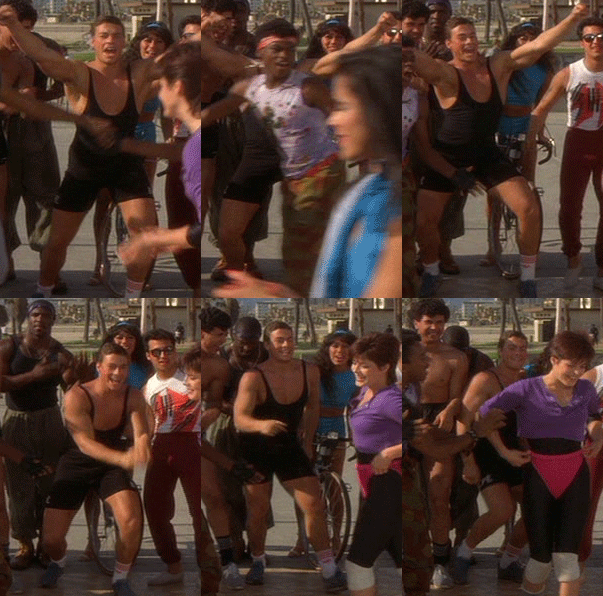
It is even whispered in some circles that some of Ken's moves were derived from the legendary Jean Claude Van Damme himself!

Mike Mahler's presentations focused on nutrition, supplementation, and how this affects our hormones and ultimately our health. He drew on a number of sources including Dr. Kessler's excellent The End Of Overeating. Mike's main message was derive as much of our nutrients as possible from clean, organic sources, and understand exactly what supplementation an individual may need to our optimize hormonal profile.
Jason Dolby lead and excellent segment on Indian club work for shoulder health on days 1 & 3. Clubs have been around a long time but are highly underrated in my opinion. Clubs have already been implemented into some of my clients training. Try it, your shoulders will thank you.
Day 2 focused primarily on kettlebell the kettlebell sport lifts and assistance work. The group spent a good 6 hours on working cleans, jerks, snatches, long cycle, and related drills. We performed a number of work sets in order to develop technique and show what sort of programming works for various purposes. The coaches made sure to present a variety of approaches to each movement, stressing that certain ways work better for certain builds, and that everyone should experiment and find what works for them. Not unlike powerlifting or any other sport.
We were fortunate to have Andrew Durniat lead the snatch portion. Andrew quite a knowledgeable guy, and has competed in Russia at the highest levels of KB sport, as well as strongman competitions and a winner of the 2009 national grip strength competition. That's him doing the KB and barbell juggling in the video below.
Following KB work there was a panel discussion during which various aspects of programming and periodization, including KB sport work, integrating Wendler's 5/3/1, integrating KBs into general fitness programs, and other concepts.
Following warm ups and mobility work on day 3, Steve Cotter was ready to open some eyes with bodyweight conditioning work derived from Chinese martial arts. Some of the drills had people muttering "no way in hell" but Steve is a great teacher and instructed how to regress each movement so that everyone could do it.
After an hour of this we ended the segment with 50 dragon twist squats. I don't know if many people made it through all 50, but we tried. And we still had the squat segment coming up. Uh oh.
Mike and Ken lead the pressing segment, assisted by John Wild, who's build is indeed well suited to wrestling dinosaurs. Despite having some back spasms John can throw a 150lbs overhead with one arm like you might lift a pencil.
Go ahead an youtube John Wild.
One topic discussed here and in the KB jerk portion is the role of thoracic mobility, and the ability to utilize thoracic extension, the ribcage, and the back in overhead movements. This concept is not very widely practiced in the West, but we could all feel an immediate difference in pressing.
Yet another reason to do foam rolling and other types of back mobility work.
Steve Cotter came back and put everyone through some great squat mobility work. This is something I find every single client needs alot of, and if you sit in a chair for more than a few hours a day you need it to.
Steve ended this portion with a squat drill that consisted of 8 sets of 10 double KB squats with minimal rest. Starting from the heaviest pair we worked our way down each set until we could barely squat our own bodyweight. My legs still remember you Steve, thanks. I guess.
Andrew Durniat ended the day with an exhibition of barbell and kettlebell juggling. He is an admirer of the deep history of physical culture, and digs these sorts of odd lifts and feats of strength. Great stuff and fun movements to play with.
All in all this was probably the best workshop I've attended, and all involved did a fantastic job. I can't express enough how cool it was to spend 8 hours each day surrounded by people so focused on physical culture and fitness - a rare treat in a time of gyms filled with chrome junk and cookie cutter training. I'm already looking forward to the next opportunity to get together with my clan.
The main theme of the workshop was that there is no one size fits all approach to fitness. In order to achieve your goals you need to figure out what works for you, or have a professional figure it out for you. But we need to understand the underlying principles in order to do this.
Among the main coaches present were Mike Mahler, Steve Cotter, "Stone Cold" Ken Blackburn, Jason Dolby, Andrew Durniat, and John Wild Buckley. And I must thank Mike Mahler for kindly allowing me to attend and help out when needed.
Each of these individuals has a unique background, skill set, knowledge base, and specialty. And together they made a hell of a group to lead a well rounded approach to fitness and well being.
Ken Blackburn lead the dynamic warmup/mobility and agility portions each day - and there were plenty of people dog tired after the initial hour of agility training, and we hadn't even lifted anything yet! Some of this mobility work would be familiar to martial artists, but not generally what one sees trainers do, something I think could use some reflecting upon. People with MA backgrounds tend to move very well and have good mobility and flexibility, so why not incorporate more of what they do?
It is even whispered in some circles that some of Ken's moves were derived from the legendary Jean Claude Van Damme himself!
Mike Mahler's presentations focused on nutrition, supplementation, and how this affects our hormones and ultimately our health. He drew on a number of sources including Dr. Kessler's excellent The End Of Overeating. Mike's main message was derive as much of our nutrients as possible from clean, organic sources, and understand exactly what supplementation an individual may need to our optimize hormonal profile.
Jason Dolby lead and excellent segment on Indian club work for shoulder health on days 1 & 3. Clubs have been around a long time but are highly underrated in my opinion. Clubs have already been implemented into some of my clients training. Try it, your shoulders will thank you.
Day 2 focused primarily on kettlebell the kettlebell sport lifts and assistance work. The group spent a good 6 hours on working cleans, jerks, snatches, long cycle, and related drills. We performed a number of work sets in order to develop technique and show what sort of programming works for various purposes. The coaches made sure to present a variety of approaches to each movement, stressing that certain ways work better for certain builds, and that everyone should experiment and find what works for them. Not unlike powerlifting or any other sport.
We were fortunate to have Andrew Durniat lead the snatch portion. Andrew quite a knowledgeable guy, and has competed in Russia at the highest levels of KB sport, as well as strongman competitions and a winner of the 2009 national grip strength competition. That's him doing the KB and barbell juggling in the video below.
Following KB work there was a panel discussion during which various aspects of programming and periodization, including KB sport work, integrating Wendler's 5/3/1, integrating KBs into general fitness programs, and other concepts.
Following warm ups and mobility work on day 3, Steve Cotter was ready to open some eyes with bodyweight conditioning work derived from Chinese martial arts. Some of the drills had people muttering "no way in hell" but Steve is a great teacher and instructed how to regress each movement so that everyone could do it.
After an hour of this we ended the segment with 50 dragon twist squats. I don't know if many people made it through all 50, but we tried. And we still had the squat segment coming up. Uh oh.
Mike and Ken lead the pressing segment, assisted by John Wild, who's build is indeed well suited to wrestling dinosaurs. Despite having some back spasms John can throw a 150lbs overhead with one arm like you might lift a pencil.
Go ahead an youtube John Wild.
One topic discussed here and in the KB jerk portion is the role of thoracic mobility, and the ability to utilize thoracic extension, the ribcage, and the back in overhead movements. This concept is not very widely practiced in the West, but we could all feel an immediate difference in pressing.
Yet another reason to do foam rolling and other types of back mobility work.
Steve Cotter came back and put everyone through some great squat mobility work. This is something I find every single client needs alot of, and if you sit in a chair for more than a few hours a day you need it to.
Steve ended this portion with a squat drill that consisted of 8 sets of 10 double KB squats with minimal rest. Starting from the heaviest pair we worked our way down each set until we could barely squat our own bodyweight. My legs still remember you Steve, thanks. I guess.
Andrew Durniat ended the day with an exhibition of barbell and kettlebell juggling. He is an admirer of the deep history of physical culture, and digs these sorts of odd lifts and feats of strength. Great stuff and fun movements to play with.
All in all this was probably the best workshop I've attended, and all involved did a fantastic job. I can't express enough how cool it was to spend 8 hours each day surrounded by people so focused on physical culture and fitness - a rare treat in a time of gyms filled with chrome junk and cookie cutter training. I'm already looking forward to the next opportunity to get together with my clan.
Wednesday, October 7, 2009
Back to Basics & workshop
It's been a couple of busy weeks so please excuse my lack of blogging.
First up today the Kettlebell In the Age of Quarrel workshop is in 2 days. I'm really looking forward to hanging out and learning from some high level coaches for three days. In addition to KB work there will be alot of work on mobility, agility, Qi Gong, animal-based movement derived from kung fu systems, and Indian clubs.
In other words, strategies and methods by which to improve our quality of movement and long term health. Anyone who has been injured or otherwise not able to move as well as they once could can attest to the impact this has on our lives.
It's not about getting ripped, it's about moving and feeling better. Once you do that then fitness can really happen.
In my experience people that have done some sort of martial arts have a kinesthetic awareness that is hard to teach in the gym. Martial arts obviously stresses moving your body without external loading (weights) in a very precise and measured manner.
Not only will you get conditioned and learn valuable skills but create an awareness of quality of movement that is important in daily life. It can be the difference between breaking your wrist or hip after a fall or being able to roll out of it.
I've gone through the car window of a careless driver throwing open their door while biking and came out without a scratch. I'm sure that little incident would have ended badly if I didn't know how to do a rolling breakfall.
Steve Cotter can move. Very well.
And while we're on the topic of moving better one exercise I see done wrong all the time, and which is very hard for many that look "fit" is the good 'ol pushup.
Eric Cressey just did a fantastic little video on how to do this seemingly basic exercise that many people have trouble with. If you struggle with pushups don't worry about how many you can do, but back up and really get your form correct and you'll end up way ahead.
I can't stress enough the multiple benefits of pushups: Core strength, glute activation, pushing strength, postural improvements.
First up today the Kettlebell In the Age of Quarrel workshop is in 2 days. I'm really looking forward to hanging out and learning from some high level coaches for three days. In addition to KB work there will be alot of work on mobility, agility, Qi Gong, animal-based movement derived from kung fu systems, and Indian clubs.
In other words, strategies and methods by which to improve our quality of movement and long term health. Anyone who has been injured or otherwise not able to move as well as they once could can attest to the impact this has on our lives.
It's not about getting ripped, it's about moving and feeling better. Once you do that then fitness can really happen.
In my experience people that have done some sort of martial arts have a kinesthetic awareness that is hard to teach in the gym. Martial arts obviously stresses moving your body without external loading (weights) in a very precise and measured manner.
Not only will you get conditioned and learn valuable skills but create an awareness of quality of movement that is important in daily life. It can be the difference between breaking your wrist or hip after a fall or being able to roll out of it.
I've gone through the car window of a careless driver throwing open their door while biking and came out without a scratch. I'm sure that little incident would have ended badly if I didn't know how to do a rolling breakfall.
Steve Cotter can move. Very well.
And while we're on the topic of moving better one exercise I see done wrong all the time, and which is very hard for many that look "fit" is the good 'ol pushup.
Eric Cressey just did a fantastic little video on how to do this seemingly basic exercise that many people have trouble with. If you struggle with pushups don't worry about how many you can do, but back up and really get your form correct and you'll end up way ahead.
I can't stress enough the multiple benefits of pushups: Core strength, glute activation, pushing strength, postural improvements.
Monday, September 14, 2009
True Unstable Surface Training
It's been awhile since I've hollered at you amigos (reference anyone?) but life has been busy. This past weekend I celebrated my birthday by trying a new sport, and discovered a truly usable method of unstable surface training (get off the damn bosu balls! haha)
Stand up paddle surfing (SUP) is a blast. Standing up and paddling wasn't as hard as I thought it would be, but I was shocked at how exhausted my lower body was afterwards, especially my adductors. Guess that's what happens when you have to keep your balance going over waves while digging in to paddle at the same time!
Go out and try this.
Over the Labor Day weekend I also had the opportunity to hang with my friends from the IKFF. Steve Cotter, Ken Blackburn, Jason Dolby, and John Wild Buckley were all there introducing a new group of people to the pleasure and pain, but mostly pain ;) of serious KB work. It was a great time as usual.
John even broke out some fun feats of strength, one arm snatching and doing various other things while holding people over his head. Here he is doing a windmill with my friend and fellow trainer Alice Nguyen.
Yep, that's pretty good shoulder stability and strength, wouldn't you say?

Stand up paddle surfing (SUP) is a blast. Standing up and paddling wasn't as hard as I thought it would be, but I was shocked at how exhausted my lower body was afterwards, especially my adductors. Guess that's what happens when you have to keep your balance going over waves while digging in to paddle at the same time!
Go out and try this.
Over the Labor Day weekend I also had the opportunity to hang with my friends from the IKFF. Steve Cotter, Ken Blackburn, Jason Dolby, and John Wild Buckley were all there introducing a new group of people to the pleasure and pain, but mostly pain ;) of serious KB work. It was a great time as usual.
John even broke out some fun feats of strength, one arm snatching and doing various other things while holding people over his head. Here he is doing a windmill with my friend and fellow trainer Alice Nguyen.
Yep, that's pretty good shoulder stability and strength, wouldn't you say?

Monday, February 9, 2009
Don't Empty Your Cup
If you know me then you might be tired of hearing about how good drinking tea is for you. And if you've trained with me then you've likely done the tea cup exercise for shoulder health.
I picked this one up more than ten years ago when I was in a Tai Chi club, and was recently reminded by my friend Steve Cotter how good it is for shoulder mobility.
Here is a a video reminder
So if you see me hauling tea sets into the gym you'll know what's coming.
I picked this one up more than ten years ago when I was in a Tai Chi club, and was recently reminded by my friend Steve Cotter how good it is for shoulder mobility.
Here is a a video reminder
So if you see me hauling tea sets into the gym you'll know what's coming.
Thursday, November 20, 2008
The Whole Enchilada
A couple of years ago after injuring my knees and back I rediscovered the importance of mobility, flexibility, and prehab work. I can't stress enough the of importance working on these qualities. Not only has my own health benefited from daily attention, but I've witnessed the condition of clients with some serious aches and pains improve drastically with some dedicated and consistent work.
Myofascial release (massage, rolling on a foam roller or ball), dynamic stretching, static stretching, and mobility work are integral and shouldn't take more than a couple of minutes a day.
In addition to helping you stay pain and injury free, another benefit of this type of work is increased agility. And let's face it, most people aren't impressed by useless bulk. Awesome displays of agility and grace are the real reason we are awed by great athletes.
My friends and colleagues Steve Cotter and Ken Blackburn founded the International Kettlebell and Fitness Federation with the goal of spreading effective ways in which everyone can increase these qualities (and more).
Check out this video of Ken demonstrating some agility drills
The amazing Steve Cotter
Granted Ken & Steve are extreme examples, but trust me that incorporating some mobility and agility work into your training will make you look, feel, and move better.
Myofascial release (massage, rolling on a foam roller or ball), dynamic stretching, static stretching, and mobility work are integral and shouldn't take more than a couple of minutes a day.
In addition to helping you stay pain and injury free, another benefit of this type of work is increased agility. And let's face it, most people aren't impressed by useless bulk. Awesome displays of agility and grace are the real reason we are awed by great athletes.
My friends and colleagues Steve Cotter and Ken Blackburn founded the International Kettlebell and Fitness Federation with the goal of spreading effective ways in which everyone can increase these qualities (and more).
Check out this video of Ken demonstrating some agility drills
The amazing Steve Cotter
Granted Ken & Steve are extreme examples, but trust me that incorporating some mobility and agility work into your training will make you look, feel, and move better.
Subscribe to:
Posts (Atom)

 Posts
Posts